
Specialist Steel Structure Solutions
Heavy Industrial Steel Structures
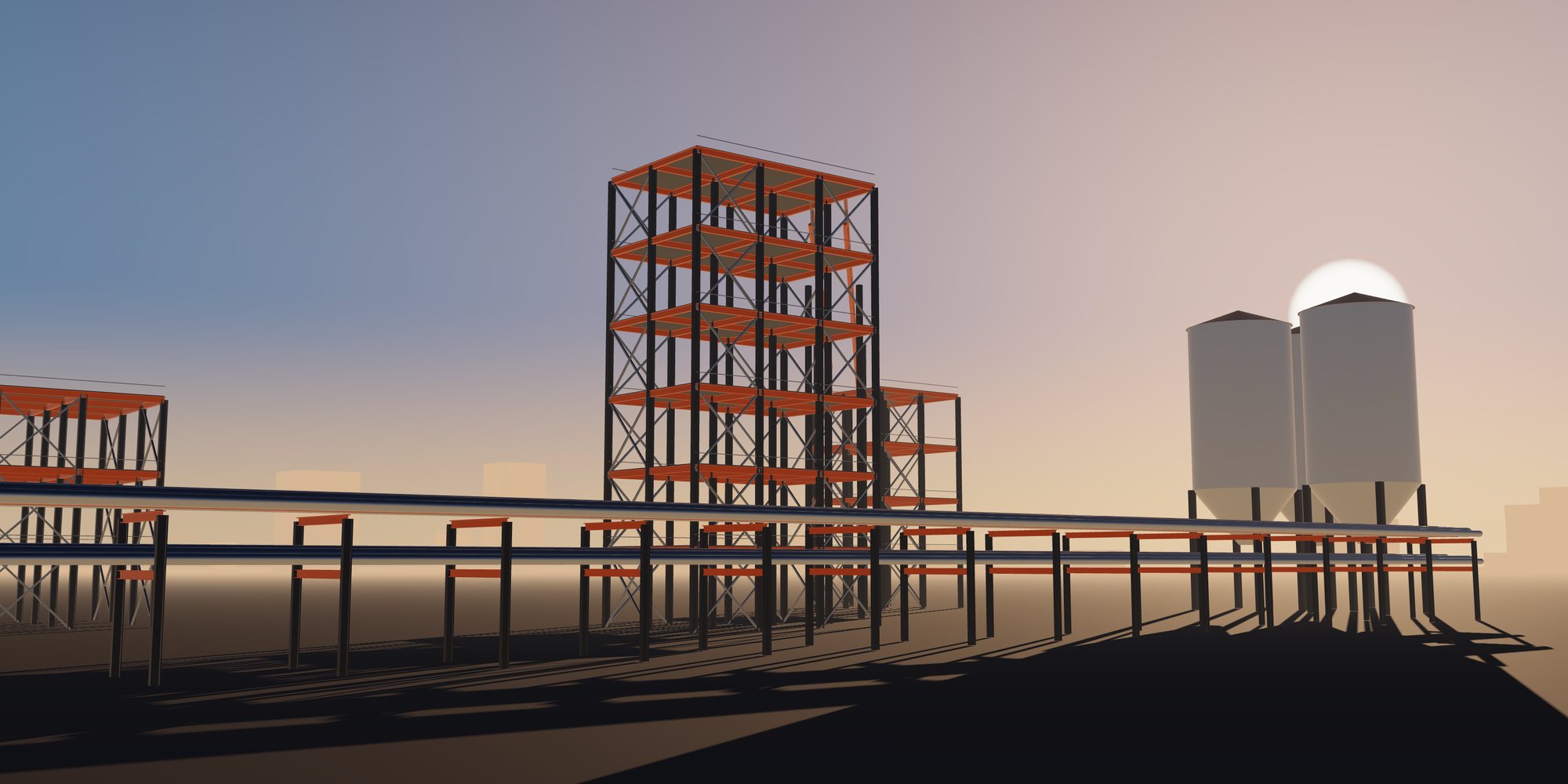
Heavy steel frames, platforms, pipe racks, plate girders and built-up members for industrial plants.
Solution Overview
Heavy industrial structures carry large equipment, dynamic and thermal loads. They commonly use built-up sections and plate girders, with bolted or welded connections detailed for transport, erection and maintenance.
Typical Applications
- Heavy Equipment Supports
- Industrial Platforms
- Heavy Steel Frames
- Pipe Racks
- Plate Girders
- Built-Up Steel Members
Sector challenges
Challenges We Engineer For
Vibration from rotating equipment
Our engineering response Dynamic analysis of equipment supports keeps natural frequencies clear of operating speeds, and stiffness is added where needed rather than mass alone.
Thermal movement in pipe racks
Our engineering response We coordinate anchor and guide locations with piping engineers and provide expansion joints or sliding bearings so thermal forces do not overload the structure.
Welding thick plate reliably
Our engineering response Qualified procedures with controlled preheat and heat input, followed by ultrasonic testing, reduce the risk of lamellar tearing and hydrogen cracking.
Transporting very heavy assemblies
Our engineering response Splice positions and module sizes are planned around road and shipping limits, with lifting points designed and documented for each piece.
Engineering Solutions
Heavy industrial structures carry loads that ordinary buildings never see. Our engineering team analyzes frames and platforms for static equipment weight, operating and test loads, vibrating machinery, thermal growth, pipe anchor and friction forces, upset conditions, blast or impact where specified, and wind and seismic loads on tall process structures. Dynamic analysis is used to keep the natural frequencies of equipment supports away from machine operating speeds, protecting both the structure and the equipment it carries.
Connections are designed for high, often reversing forces, using full-penetration welded joints, heavy bolted splices and stiffened bases. We work to AISC 360, CSA S16, AS 4100 or Eurocode 3 as specified, and align with the project engineering specifications typical of process, energy and mining owners. Anchor bolt groups and base plates are checked for combined tension and shear from equipment and wind.
Engineering Considerations
- Dynamic and vibrating equipment loads
- Thermal expansion of pipe racks and anchors
- Plate girder stability, stiffeners and weld sizing
- Transport limits for heavy assemblies
- Access, platforms and maintenance clearances
One coordinated scope
From Engineering to Delivery on Site
Design optimization, fabrication, quality control, surface protection, export logistics and erection support managed as one scope, so interfaces between design, shop and site stay under control.
-
Design Optimization
Value engineering in heavy industrial work focuses on load definition and modularization. We challenge conservative load allowances with vendor data, size plate girders with optimized web depth and stiffener spacing, and select between rolled and built-up sections by availability and fabrication effort. Pipe racks are arranged with modular bays that can be pre-assembled. Splitting heavy assemblies at transport-friendly splices avoids oversized shipments while keeping site connections simple.
-
Fabrication Solutions
Typical members include deep plate girders, built-up box and I-sections, heavy columns, equipment support frames, grating platforms, stairs and pipe rack modules. Thick plates may require preheat, controlled heat input and qualified procedures to the AWS D1.1, AS/NZS 1554.1 or EN 1090 execution class specified, often EXC3 for heavily loaded or dynamic elements. Bearing surfaces and machinery support plates are machined where flatness is critical.
Pipe rack modules and complex assemblies are trial-assembled in the shop where specified, then match-marked for reassembly at site. Lifting lugs and temporary transport bracing are designed and fabricated as part of the scope. Platforms, stairs and handrails are detailed for safe maintenance access and fabricated as bolted sections, which allows them to be galvanized separately and installed after the main frame.
-
Quality Assurance
Our inspection and test plan reflects the criticality of each element, with hold points on thick plate welding, preheat records and post-weld checks. Mill certificates, including through-thickness and toughness properties where specified, are traced to every piece. Ultrasonic testing is applied to full-penetration and thick plate welds, with magnetic particle testing on fillet welds and radiography where the project specification requires it. Dimensional surveys confirm girder camber, flatness of equipment seats and bolt hole patterns, documented in a complete quality dossier.
-
Surface Protection
Industrial plants often expose steel to C4, C5 or CX environments with chemicals, high humidity, salt or abrasive dust. We select ISO 12944 systems for high durability, typically zinc-rich primers with epoxy and polyurethane coats, or hot-dip galvanizing for platforms, gratings and handrails. Hot surfaces may need heat-resistant coatings, and passive fire protection is coordinated for hydrocarbon fire scenarios where specified. Bolted connection faying surfaces are treated to meet slip requirements.
-
Export & Logistics
Heavy assemblies are planned around transport limits from the start. Pipe rack modules, plate girders and large frames are shipped break-bulk or on flat racks with engineered lifting points and sea fastening, while grating, stairs, handrails and bolts are containerized by area. Shipments are sequenced to the plant construction schedule. Each consignment carries packing lists, weight and center of gravity data for heavy pieces, and full export documentation.
-
Erection Support
We provide erection drawings, lifting point details, weights and centers of gravity for major lifts, and module reassembly instructions. Our engineers give input to method statements and lift plans prepared by the erection contractor, including temporary support of plate girders and sequence of pipe rack installation around existing plant. Technical supervision or advisory support is available when agreed. Erection is performed by the client appointed contractor.
What You Receive
Typical engineering, fabrication and quality documents for this type of structure. The final list is agreed for each project.
- Design basis report covering equipment, thermal and dynamic loads
- Structural calculation report including dynamic checks
- Connection design calculations for heavy and moment connections
- IFC general arrangement drawings and BIM model coordinated with piping
- Shop drawings, erection drawings and module assembly drawings
- Lifting point details with weights and centers of gravity
- ITP, weld procedures, NDT reports and mill certificates
- Packing lists and shipping documentation for break-bulk and containers
Global supply
Supplying Projects Worldwide
Engineering and documentation aligned with the codes, approvals and logistics of each market we supply.
-

Steel Structures for the United States
Structural steel for US projects designed and documented to AISC, ASCE 7 and AWS practice, with the submittals and traceability US…
-

Steel Structures for Canada
Steelwork for Canadian projects to CSA S16 design and CSA W59 welding, with welding-company certification and cold-climate material…
-

Steel Structures for Australia
Fabricated steel for Australian projects to AS 4100, AS/NZS 5131 and AS/NZS 1554.1, with construction category, cyclone wind actions and…
-

Steel Structures for New Zealand
Seismic-ready steelwork for New Zealand to NZS 3404 design and AS/NZS 5131 fabrication, with ductility, connection capacity design and…
-


Steel Structures for Europe
Structural steel components for European projects designed to the Eurocodes with National Annexes, and executed to EN 1090 with the…
-

Steel Structures for Japan
Steel supply for Japanese projects under the Building Standards Act framework, JIS-designated materials and fabricator grading, with…
-

Steel Structures for South Korea
Steelwork for Korean industrial and building projects aligned with the Korean Building Code and KS material standards, with fast-track…
-


Steel Structures for Southeast Asia
Regional steel supply across Singapore, Malaysia, Thailand, Vietnam, Indonesia and the Philippines, where each country's code basis…
-


Steel Structures for the Middle East
Steelwork for Gulf and Middle East projects specified to international codes by consultants, with extreme heat, sand and saline exposure…
-
Other International Markets
For markets not listed separately, we start from the project specification: governing code, material standards, inspection regime and…
Frequently Asked Questions
Can you work to owner engineering specifications?
Yes. Process, energy and mining owners often have their own structural and coating specifications. We review these at the start, flag any conflicts with the referenced codes, and apply them throughout design, fabrication and inspection.
Do you design for vibrating equipment?
We carry out dynamic checks on supports for pumps, compressors, fans and screens using vendor data. Where vendor data is incomplete, we agree design assumptions with the client and verify once final data is received.
How large can pre-assembled modules be?
Module size depends on the transport route, port handling and site lifting capacity rather than a fixed limit. We study these constraints early and size modules so that they can be shipped and installed safely.
Discuss Your Heavy Industrial Steel Structures Project
Share your drawings and requirements. Our engineering team reviews the scope, the governing design code and the delivery conditions, then responds with the next steps.
Helpful to include
- Architectural or structural drawings, or a sketch of the layout
- Project location and site conditions
- Governing design code and any client specifications
- Key loads: cranes, equipment, wind or seismic data if known
- Required scope: design, fabrication, coating, supply, erection support
- Target schedule and delivery terms
Files attached to the request form are stored privately and are visible only to authorized staff.